
Father’s Lesson—
from my debut poetry book Lost Mother
My first rolling was in nursery days.
My teacher’s word was like a hammer to me
when she told me to write eight.
Sweat began to trail — in winter days.
I, a novice couldn’t help, came to the lap of my father.
He drew two round spectacles on the paper,
then effaced the bar between the circles.
I caught my wisdom at once
and stuck both circles —
Eight (8) was there.
I still stick to it,
though he is no more.
I wrote this poem from a childhood memory that never left me. I was struggling to write the number eight, my pen caught in the labyrinthine of a serpentine path. With a wit I made two circles of a spectacle and a bar between them. My father smiled, erased the bar, and said, “Join them.” That moment was my first lesson in creation — how perfection often arrives not by adding, but by removing. Years later, I realised that the same rule applies to grammar. It begins as a bar of order, and one day, if you have learnt deeply enough, you efface it. You connect the circles.
I am reading The Summing Up by Somerset Maugham these days. It reads like a man talking to himself after the long voyage of writing. His childhood, as he describes, had the pale grayness of English restraint. People used to call his parents Beauty and the Beast. His mother was admired for her charm; his father was plain, even ugly. When someone asked why she lived with such a man, she replied, “Because he never hurts my feelings.”
That one line contains Maugham’s entire world — polite, gentle, morally balanced. Before turning to literature, he studied medicine, but he left it soon after. He could not bear the sight of blood. Perhaps he was not meant to heal bodies, but to understand wounds of the spirit. His scalpel turned into a pen.
Maugham believed in grammar as one believes in conscience. For him, clarity was not style but ethics. Later, V. S. Naipaul, who admired him deeply, carried this discipline forward into another century. For both, grammar was civilization itself — a fence against the chaos of emotion.
I respect that. Grammar steadies the hand; it gives shape to thought. But when the storm rises — when feeling and abstraction surge together — grammar begins to tilt. It resists, then trembles, then yields. It is not rebellion; it is rhythm.
Shakespeare, with very little schooling, wrote by instinct. His grammar was lived, not learned. His sentences swell and ebb like tides, carrying music and madness in one motion. Tennyson, on the other hand, polished every syllable till it gleamed. But polish can also imprison. His verse stands perfect, but sometimes breathless, as though perfection itself had stopped the pulse.
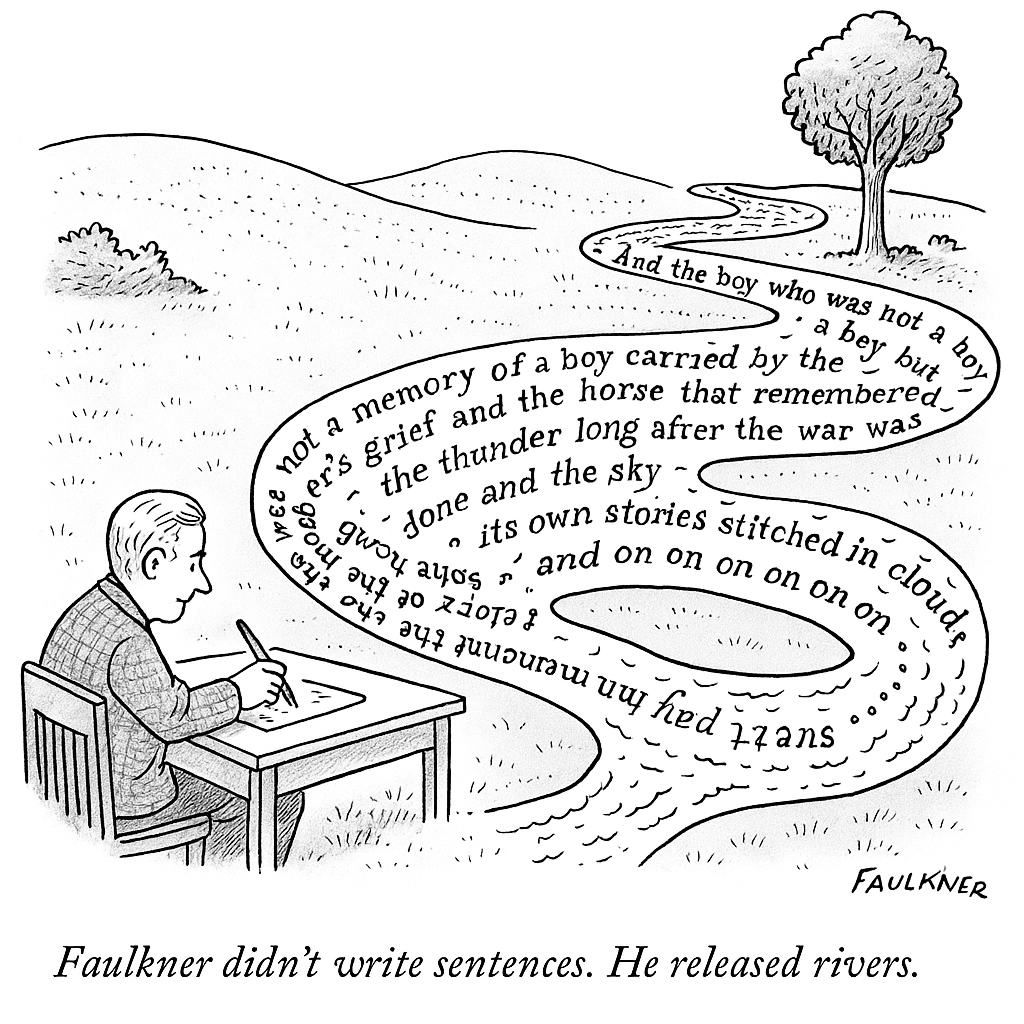
The legendary writers — those few whom time itself crowns — never follow grammar fully. They create their own. Dostoevsky’s syntax shivers with fever; Faulkner’s sentences flow like wild rivers; Woolf lets grammar melt into thought. They are not careless — they are consumed. Grammar in their hands does not collapse; it transforms.
Maugham and Naipaul, for all their mastery, now seem to be stepping back into a gentler memory. Not gone, but less blazing. They remained too faithful to order. Time tends to remember not the flawless, but the fevered — those who wrote as if grammar itself had caught fire.
I am not against grammar. I bow to it. It is the house in which every writer must live. But the windows must stay open. Grammar gives structure; passion gives breath. To write only by rule is to build a skeleton; to write only by feeling is to scatter dust. The miracle lies in the trembling balance — the house still standing, yet the storm moving inside it.
Perhaps grammar is like medicine. It diagnoses and defines, but cannot touch the mystery of fever. Maugham could not face blood; the great ones faced it and wrote with it still warm on their fingers.
Every writer must decide what they can bear — the calm of order or the risk of storm. Grammar protects; passion burns; art is born between the two.
Language, like life, shines only when it shakes.
From Satire Section:—Faulkner didn’t write sentences. │
│ He released rivers.” │

 Pragya’s Pen
Leave a comment