
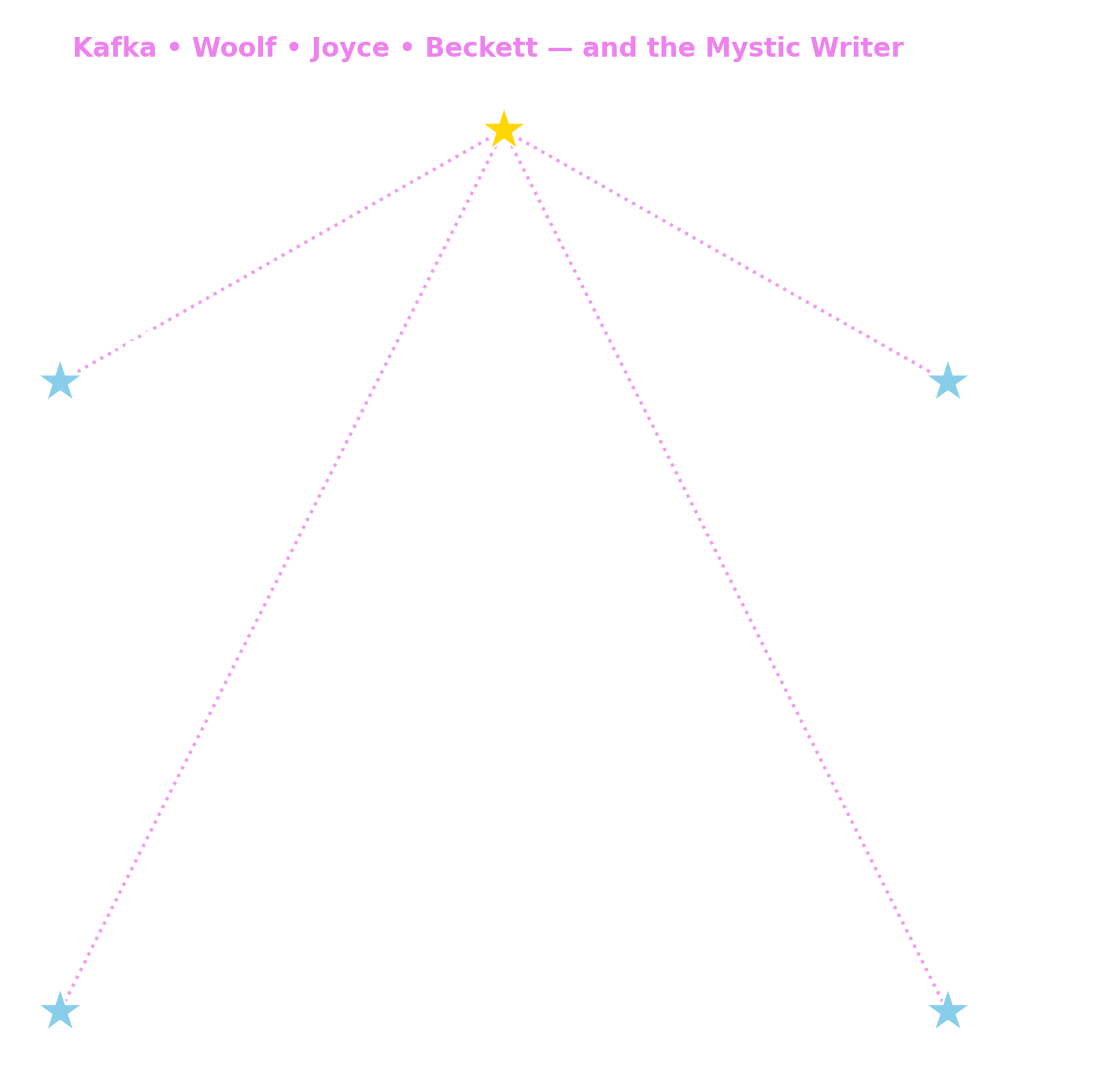
Greatness, whether in the path of yoga or in the path of art, lies in one direction only: inward. The yogi leaves behind the body, then the mind, and finally the soul dissolves into its own essence. Body, mind, soul — the layers peel away until nothing external remains.
In literature, the true artist performs the same movement. Traditional narrators live in the body of prose. They describe actions, events, characters moving in a visible world. Their art is muscular, full of story-flesh. It satisfies the eye and the appetite, but it does not pass into the sanctum.
The great experimentalists of the twentieth century — Joyce, Woolf, Kafka, Beckett — carried prose through the yogic layers. They showed that the novel need not remain a body at all; it could leave flesh and enter the mind, or even deeper.
Muscle Writers
Dickens, Balzac, Tolstoy, Naipaul — they are masters of narration, builders of worlds, sculptors of character. Their prose is a strong body, their art muscle. But even at its height, it remains tied to the outer layer.
Virginia Woolf: The Mind’s Flow
Woolf left the body behind. In Mrs. Dalloway or The Waves, the story is not what happens but how a thought ripples, how memory flashes and dissolves. She dissolved narration into rhythm, becoming a mind-writer.
Kafka: Between Body and Mind
Kafka kept the fable-body but filled it with the anguish of the mind. A man turned insect, a castle looming, an arrest without reason — all wear outer shape, yet inside burns terror, absurdity, the absolute. Kafka is seventy percent mind, thirty percent muscle. His stories still wear their bodies, but the soul pushes outward, pressing against the skin.
Beckett: The Bare Mind
Beckett shed the skin altogether. His prose is nearly bodiless — stripped of plot, character, even sentence. Words fall like bones, silence spreads between them. The story lives not in narration but in the gap, where the reader suffers to assemble meaning. Beckett is ninety percent mind, a yogi-writer whose scripture is silence.
Joyce: From Muscle to Chant
Joyce began in muscle. Dubliners are tied to the flesh of ordinary life; Portrait balances on the threshold. By Ulysses, he enters the labyrinth of the mind, and by Finnegans Wake he leaves the body altogether. His language becomes dream, chant, inner liturgy. It is no surprise that Beckett made Joyce his idol. Joyce had already walked ahead into the same country of mind where narration vanishes into pulse.
The Shared Journey
A yogi moves from body to mind to soul. A writer too. From narration, to consciousness, to silence. Both journeys end in abstraction, depth, inner vision.
So when I look at Woolf, Kafka, Beckett, Joyce, I do not see only literary innovators. I see yogis in prose. Their books are meditations, austerities, inner journeys. They are immortal not because of fashion or reputation, but because they achieved what mystics achieve: they entered the inner world, leaving the outer behind.
Today’s Genre Thought
Genres are shelves, not souls. They belong to markets and bookshops, not to writing itself. When words rise from consciousness, from that pulse deeper than thought, they carry no label. Break Kafka into lines and it is poetry; stretch Woolf back into paragraphs and it becomes a story. The soul writes without form. Rhythm releases itself. Only later do we name it “novel,” “poem,” “diary.” Genre is nothing but commerce casting its shadow across the page.
Magical Strikes ✍️
They come unbidden — as Kafka said, “like a gift from the night.” Pen in hand, and suddenly a line spills out, sharp, balanced amid the storm. Such sentences carry rhythm, contrast, philosophical weight — things usually achieved only after many revisions. But magical strikes need none. When they arrive, they anchor a chapter, sometimes even a whole book.
I call them magical strikes — the rare instant when the inner self and the voice of literature meet as one.

 Pragya’s Pen
Leave a comment