
“Great art is born only when knowledge is transfigured into feeling.”
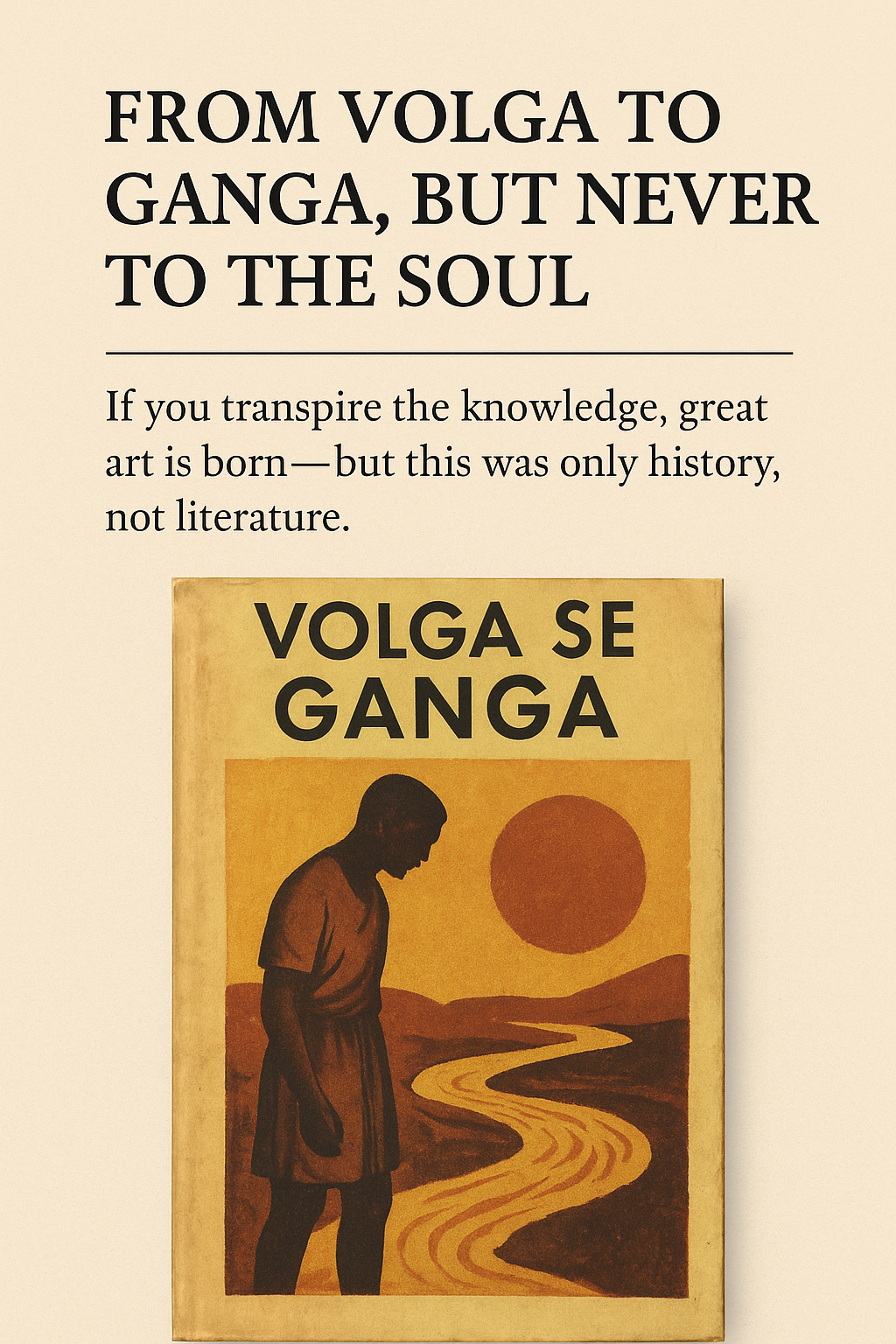
Volga se Ganga (From Volga to Ganga) by Rahul Sankrityayan—when I read it for the first time, I didn’t dive through or formulate it with my own eyes, which were still in the aura of the great name of Hindi literature. After rereading it after a decade, it filled me with a stifling sense, as if it were more a collection of anthropological case studies than living, breathing fiction. The characters, rather than being psychologically complex beings, appeared merely as vessels to convey ideas. Even the prose is tepid, and in its dry, didactic tone, it seems to teach more than it evokes. That bureaucratic language undermines any potential for artistic transcendence.
And the ideological slant is solidly present—each era’s protagonist conveniently echoes a Marxist interpretation of history, projecting class struggle and social progress as the core driving forces. It aligns too neatly with the historical materialism endorsed by Soviet-influenced academia. In India, the book became part of the Nehruvian intellectual fabric, celebrating the “scientific temper,” progress, and socialist utopianism—establishing it as a canon in a very specific political era.
Volga se Ganga, devoid of literary and artistic merit, owes its fame largely to historical convenience. The Congress regime in India, with its Soviet leanings, needed “national” narratives that spanned centuries but aligned with modernist socialist ideas—and Rahul Sankrityayan delivered on the Congress platter. The book is less about artistic merit and storytelling, and more about building an ideological bridge from the Indus Valley to Communist utopia. It is propaganda dressed in the garb of historical fiction, where literature becomes a tool for nation-building rather than self-exploration or art.
The book’s literary mediocrity contrasts sharply with the scale of its ideological footprint. The fact that Vladimir Putin cited Volga se Ganga as a favorite says more about geopolitics and cultural symbolism than literature itself. It fits the larger post-Soviet nostalgia and shared historical narratives between Russia and India during the Cold War. The book aligns with Eurasianist themes—civilisational continuity, historical struggle, ideological destiny—all buzzwords that someone like Putin gravitates toward.
So while the world has truly great literary works—Dostoevsky, Camus, Márquez, Kafka—this book gets name-dropped for its utility in soft power and ideological kinship, not because it can stir the soul. Rereading compelled me to think—this is not a book worthwhile to read as great literary fiction. But the reading was not worthless—without it, I wouldn’t have dug into its machinery.
“Great art is born only when knowledge is transfigured into feeling.”
Postscript:—This is part of my ongoing reflections on ideological literature and its place in postcolonial India.”


 Pragya’s Pen
Leave a comment