
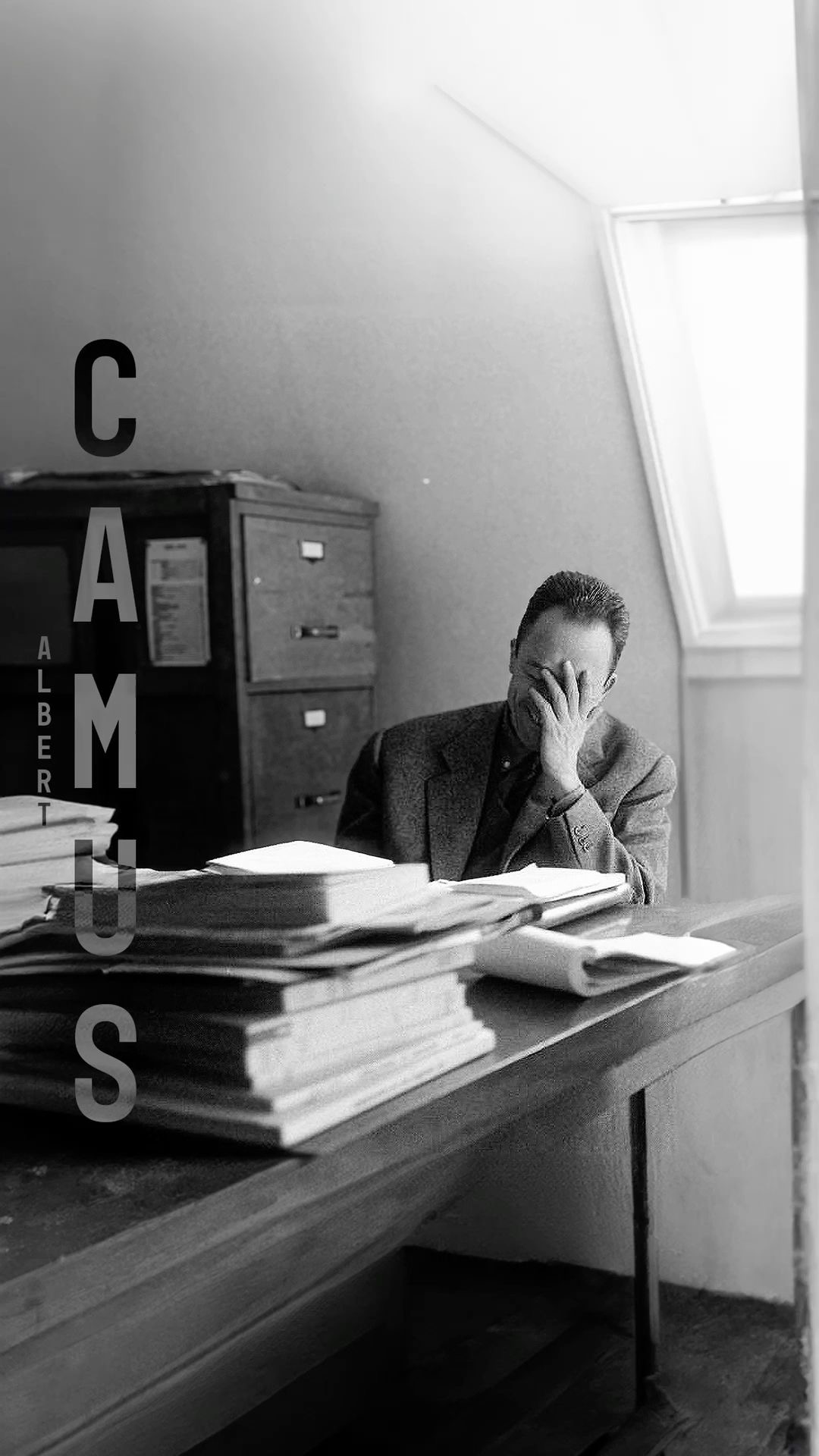
Albert Camus’ absurdism and Philosurreal postmodern Mystic both deal with the nature of existence, but they diverge in their approach to meaning, detachment, and the role of art. Camus, rooted in existential thought, viewed the absurd as an unresolvable conflict between human desire for meaning and the silent, indifferent universe. Philosurreal postmodern Mystic, however, does not see the absurd as a contradiction to be endured but as a gateway to fluidity, where logic dissolves into sensation, paradox, and mystical abstraction.
The Core of Camus’ Absurdism
Camus defines the absurd as the confrontation between man’s search for meaning and the unresponsiveness of the universe. His philosophy does not propose a resolution; instead, he urges us to embrace the absurd, rejecting both religious illusions and nihilistic despair. His characters—Meursault in The Stranger, Dr. Rieux in The Plague—navigate existence with a kind of stoic defiance. They do not seek transcendence; they simply endure. Camus’ vision is grounded in detachment, where emotional distance is a shield against the irrationality of life.
Philosurreal Postmodern Mystic: A Different Lens
Philosurreal postmodern Mystic, on the other hand, does not stop at the absurd. It does not merely accept the meaninglessness of life; it bends, distorts, and reimagines it. It allows detachment and attachment to coexist in fragments, where contradictions are not conflicts but natural states of being. In Camus, absurdism leads to a cold acceptance, while in Philosurreal Postmodern Mystic, it transforms into a mystical, dreamlike engagement with reality.
1. Absurdity vs. Mystical Fluidity
• Camus sees the absurd as something to accept without resolution.
• Philosurreal postmodernist Mystic sees the absurd as a fluid space where logic, dreams, and mysticism intertwine.
2. Detachment vs. Distilled Attachment
• Camus’ characters often remain emotionally distant, engaging with life through resigned participation.
• Philosurreal Postmodern Mystic embraces what I call “distilled attachment”—a paradoxical engagement where detachment does not erase feeling but refines it into something subtler, more surreal.
3. Cold Analysis vs. Poetic Sensation
• Camus intellectualizes suffering, making it an object of analysis rather than immersion.
• Philosurreal Postmodern Mystic immerses suffering in poetic abstraction, allowing emotion to unfold rather than dissecting it.
The Artistic Divide
Albert Camus’ writing is poetic in places, but it ultimately follows a rational structure. In The Fall though monologue narration fractures to mirror the exential crisis, in the core philosophical argument is stuck. Philosurreal Postmodern Mystic believes meaning doesn’t need to be constructed—it emerges, dissolves and reemerges. Here fragmentation is not a stylistic choice, but an organic reality.
In Camus absurdism a man stares at an indifferent sky, while in Philosurreal Postmodern Mystic, the man walks through fog where shapes shift, meanings blend, and detachment doesn’t eliminate feeling but transform it to something ineffable. It doesn’t conclude but lingers like a dream that refuses to be fully remembered. Here there is no definite answer.
In the end Camus is confined within the limits of rationality, despite confrontation with absurdity. Philosurreal Postmodern Mystic doesn’t confine but moves beyond, where reason collapses into sensation, where contradictions coexist, and where truth is not destined for acceptance or denial, but it lingers to be felt in fragments, dissolving, and reforming endlessly. Philosurreal Postmodern Mystic believes the infinite divine cannot be caged in words, just as the world resists rationalization. It is not a puzzle to be solved, but an experience to be lived.
My Critique of Camus
In Albert Camus’ love for the Mediterranean, a sensual almost hedonistic element exists which aligns with his broader philosophy of the absurd—embracing life’s pleasures despite its lack of inherent meaning. His description of the sea, sun, and beaches carries an undertones of physical desire and appreciation for beauty, including allure for the women. I always think—Camus died at 45 years old. Had he lived longer and experienced the calamities of old age and disease, would the sea still have attracted him for its physical pleasures? Or would it have become a place of desolate musings? A person who did not experience the full arc of life—how could he postulate a complete philosophy?
Albert Camus is a peg top colliding in contrast—absurdism versus moral responsibility, freedom versus the indifference of the universe. In The Stranger, Meurault’s interactions with Marie by the sea, and his detachment even in moments of intimacy reflect this blend of sensual experience and existential indifference.
In his Notebooks, September, 1945–April 1948, he has written—“As the age of twelve she is raped by a coachman. Just once. Until the age of seventeen, she has the idea of a sort of defilement.” This is an example of Camus’ extreme cold observational style, where a human being is reduced to a philosophical dissection, stripped of morality, and feeling. I don’t think this is a universal element in his writings. His novels like The Plague, and The Fall, show a nuanced engagement with suffering, morality, and human responsibility. Perhaps writing in a philosophical mood would have taken him in a desert for a moment. It is one of the dangers of dry absurdist philosophy, where an exential curiosity has replaced the deeply felt reality.
Here Philosurreal Postmodern Mystic offers an alternative: Keep the emotional depth intact amid the exploration of fragmented paradoxical nature of existence. Absurd Camus fluctuates in a non cosmic world—sometimes in a shell of inhuman detachment, sometimes a moral figure. Philosurreal Postmodern Mystic is an answer to this—retaining the complexity of existence without sacrificing the depth of feeling. Instead of dissecting human experience, you let it unfold organically, embracing both its contradictions and its emotional weight.
‘Camus lets Sisyphus push the rock endlessly, but the Philosurreal Postmodern Mystic sees the rock dissolve into mist.’

 Pragya’s Pen
Leave a comment